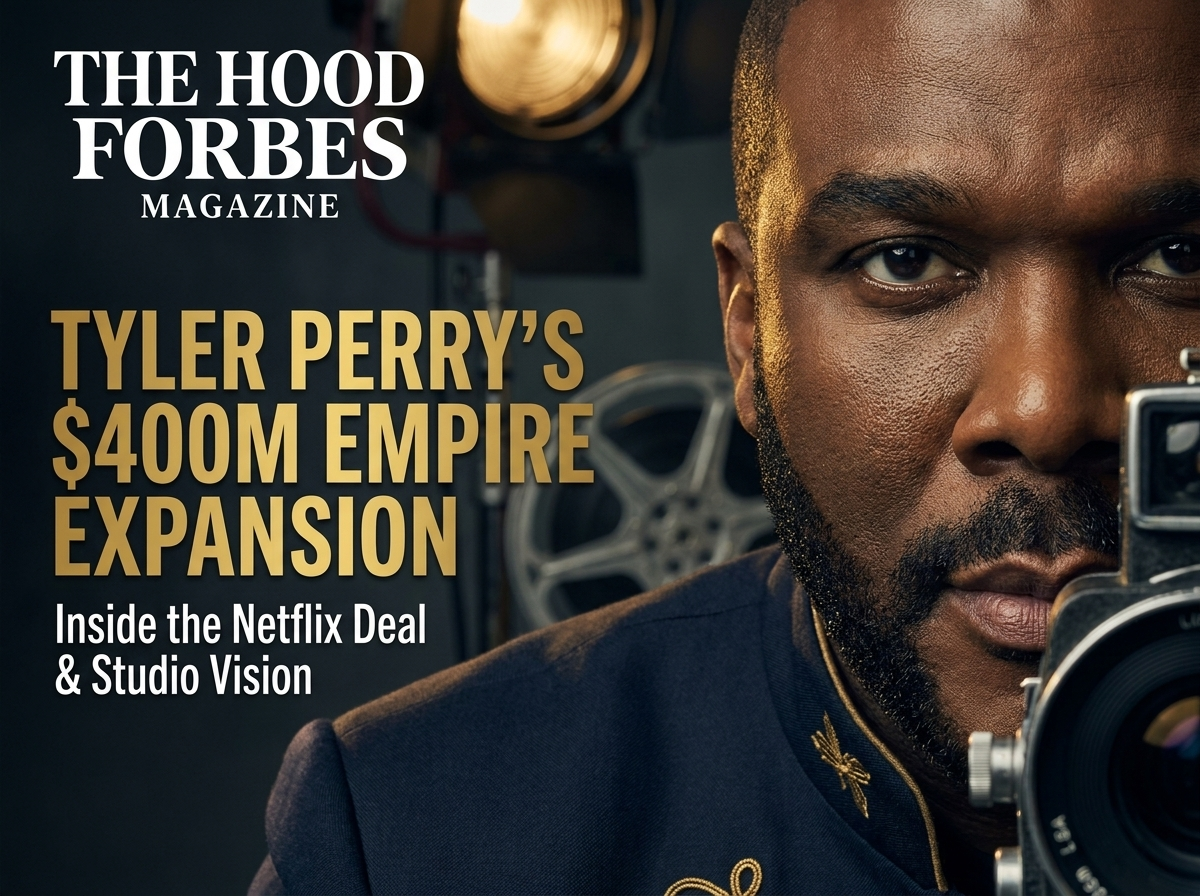
Tyler Perry Just Closed a $400M Netflix Deal for Tyler Perry Studios — Black Hollywood Got a Whole Lot Bigger
Jerome Carter
July 9, 2026 · 9 min read
He built his first studio on a decommissioned military base in Atlanta. Now Tyler Perry is expanding his empire through a landmark Netflix deal that cements Tyler Perry Studios as one of the most powerful independent production houses in the world.
In 2019, Tyler Perry opened Tyler Perry Studios on the former Fort McPherson military base in Atlanta — 330 acres, twelve soundstages, a full backlot. He bought it. He owns it. The deed is in his name.
At the opening ceremony, he told the crowd something that Hood Forbes still comes back to: "I want to be an example that it is possible to own your own network, your own distribution."
In 2026, he closed a $400 million expansion deal with Netflix that proves he wasn't speaking theoretically.
What the Deal Actually Means
A $400 million Netflix expansion deal is not a content licensing agreement where a studio gets paid to make shows for a platform and hands over the rights. At Tyler Perry's level, with Tyler Perry's leverage, these conversations happen differently.
The deal expands the volume and scope of Tyler Perry Studios content on Netflix — securing resources for production while preserving the ownership and creative control infrastructure that Perry has spent thirty years fighting to protect. Netflix gets access to one of the most loyal and consistently underserved audiences in American entertainment. Tyler Perry Studios gets capital, global distribution, and the validation of a partnership with the most powerful streaming platform on earth.
The math works for both sides. But the cultural significance lands entirely on one side of that table.
The Fort McPherson Move Was the Blueprint
You cannot understand the Netflix deal without understanding what Perry did in 2015 when he paid approximately $30 million for the Fort McPherson property.
He did not build a studio on leased land. He did not take a partnership stake in someone else's facility. He bought the land, bought the buildings, built the infrastructure, and created the largest studio owned by any individual Black person in American history.
That decision — which looked audacious at the time and looks visionary now — changed every negotiation that followed. When you own the physical infrastructure, you negotiate from a fundamentally different position. You are not a vendor. You are not a tenant. You are an institution.
Netflix is not coming to Tyler Perry with a content deal. Netflix is coming to Tyler Perry Studios — a building, a campus, a physical monument to Black ownership that sits on 330 acres of Atlanta soil.
That distinction is everything.
The Madea-to-Mogul Pipeline
Perry's career trajectory is one of the most underanalyzed business stories in American entertainment.
He started in theater — writing, producing, and performing his own plays for Black church audiences that mainstream entertainment had completely ignored. He built an audience before he had a distribution deal. He built loyalty before he had a platform. By the time Hollywood came looking, he had leverage.
The Madea franchise became the engine that funded everything else. Critics dismissed it. Perry reinvested the profits into ownership. He used the revenue from movies that cost $5 million to make and grossed $100 million to buy real estate, build infrastructure, and construct the physical foundation for a studio empire.
He played a long game that the industry didn't understand because the industry wasn't paying close enough attention.
They're paying attention now.
Atlanta Is Not a Coincidence
Tyler Perry built his empire in Atlanta deliberately. The city's infrastructure for Black business, Black entertainment, and Black wealth creation — the HBCUs, the established professional class, the cultural identity — made it the right foundation for what he was building.
And as Tyler Perry Studios grew, it accelerated Atlanta's emergence as a genuine rival to Hollywood for film and television production. The Georgia film tax incentive structure helped. The weather helped. But Tyler Perry's presence — and the legitimacy it conferred — was a signal that brought other studios, other productions, and other investment into the ecosystem.
He built something that made the city bigger. And the city made his something worth more.
That is how real empire-building works at its best.
The Blueprint for the Hood
Tyler Perry's story contains a lesson that applies regardless of industry or scale: the path from creator to institution runs through ownership of infrastructure, not just output.
He could have been a content creator. He chose to be a studio owner. The difference in generational wealth between those two positions is the difference between a salary and a building.
A $400 million Netflix deal happens because he owns 330 acres in Atlanta.
The ownership came first. The deal followed.
Build the infrastructure. The deals will come to you.
Move accordingly.
Did you enjoy this article?
Written by
Jerome Carter
Staff writer at The Hood Forbes Magazine covering business, wealth, and culture.