His Name IS the Business: How TD Jakes Built One of the Most Sophisticated Commercial Empires in Black America
Hood Forbes Editorial
July 16, 2026 · 12 min read
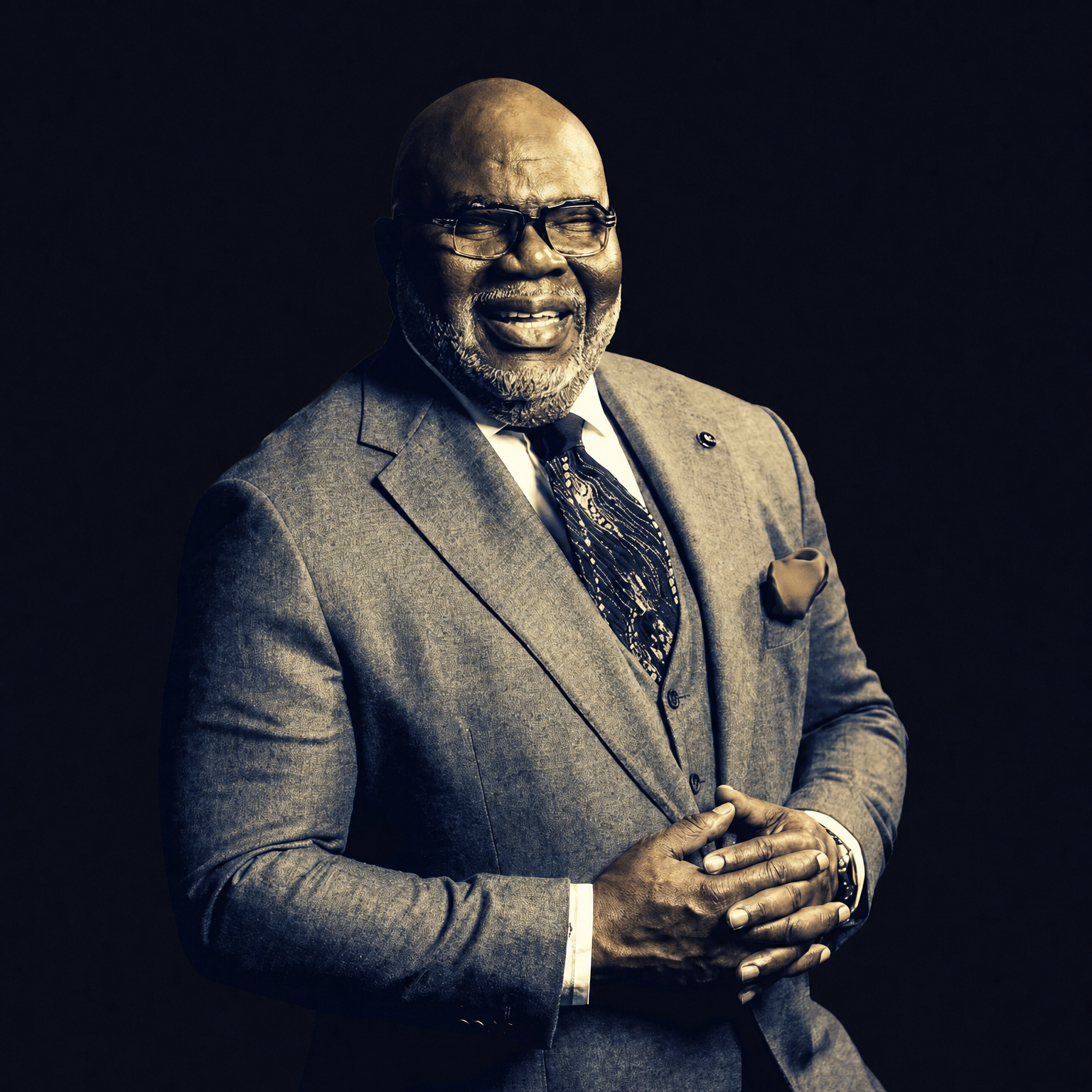
While the internet was busy arguing about the man, the wise were studying his blueprint. TD Jakes took two initials and a surname and turned them into a fully operational holding empire — with his name at the center like a sun and a solar system of distinct legal entities orbiting around it.
While the internet was busy arguing about the man, the wise were studying his blueprint.
Thomas Dexter Jakes did not just build a ministry. He did not just write books, produce films, or preach to packed arenas. He did something far more calculated — far more architectural — than any of that. He took two initials and a surname and turned them into a fully operational holding empire, with his name sitting at the center like a sun, and a solar system of distinct legal entities orbiting around it, each one structured to do a different job, each one protected from the others, the whole machine generating revenue, influence, and legacy simultaneously.
This is not a story about faith. This is a story about structure.
Where It Started: Nothing But a Name and a Vision
West Virginia, 1957. Thomas Dexter Jakes is born in the kind of place that doesn't make the business press. His father, Ernest Jakes Sr., ran a small janitorial business. His mother, Odith, was an educator. The family was working class. The environment was not one of inherited wealth or connected networks.
When his father died of kidney failure, TD Jakes was 16. He watched his mother hold the household together. He watched what happens when a family has no assets, no structures, no protection — just labor and prayer. He started preaching at 17 in a small church with less than 100 members in Montgomery, West Virginia. He charged five dollars a week in tithes. There was no commercial vision yet. There was just a man with a gift and nothing to lose.
By the early 1990s, that gift had become undeniable. His message was landing. His speaking ability was transcendent. And somewhere in that period — somewhere between the small churches and the arena stages — TD Jakes made a decision that most preachers never make: he decided to treat his calling like a business. Not to diminish it, but to protect it, scale it, and make it sustainable in ways that a single organization never could.
What came next was one of the most impressive legal and commercial structures in Black American entrepreneurial history.
The Hub-and-Spoke Architecture: How tdjakes.org Reveals Everything
Go to tdjakes.org right now. Don't look at it devotionally. Look at it architecturally.
His name is the website. Not "pottershouse.org." Not "jakesenterprisesgroup.com." His government name — TD Jakes — is the master brand, the mothership, the URL itself. And orbiting that name, like planets around a sun, are a collection of distinct entities, each with its own function, its own legal status, its own purpose.
This is the hub-and-spoke model. And it is genius.
The hub is TD Jakes — the man, the name, the brand. The spokes are the entities. Each spoke generates revenue, influence, or tax protection. Each spoke isolates risk. If one spoke breaks, the hub keeps spinning. If one entity gets sued, faces financial pressure, or undergoes restructuring, the others are insulated by their own separate legal formation.
Let's walk the solar system.
The Potter's House: The Foundation, Protected
The anchor entity is The Potter's House — the Dallas megachurch that serves as the non-profit ministry arm of the empire. But this isn't a generic 501(c)(3). The Potter's House operates as a church under IRS classification 508(c)(1)(A), which carries its own unique protections. Under this designation, the organization is automatically tax-exempt without needing to file for separate exemption. Contributions are tax-deductible. And unlike 501(c)(3) organizations, a 508(c)(1)(A) is explicitly protected under the First Amendment as a religious organization — meaning the government has more limited authority to investigate or impose restrictions on its activities.
The Potter's House grew from a 50-person prayer circle in 1996 to a congregation of over 30,000 members at its Dallas, Texas location — one of the ten largest churches in the United States. It has satellite locations internationally and runs extensive community programming, counseling, recovery ministries, and care services.
From a structural standpoint, The Potter's House is the trust anchor of the entire empire. It is the organization that carries the credibility of TD Jakes' ministry and the tax protections of religious organization status. Everything else in the solar system benefits from the gravitational credibility of this institution — but because it is legally separate from the commercial entities, its tax-exempt status does not bleed into or subsidize commercial operations. The wall is clean. The structure is airtight.
This is not accidental. This is architectural.
T.D. Jakes Enterprises: The Commercial Engine
If The Potter's House is the spiritual foundation, T.D. Jakes Enterprises is the engine room.
This is the commercial operating company — the for-profit entity that handles books, film production, leadership development, and corporate partnerships. When TD Jakes publishes a book, the deal runs through the Enterprises arm. When he produces a film — and he has produced several, including the critically recognized Woman Thou Art Loosed franchise and collaborations with major studio partners — that production runs through the Enterprises infrastructure.
The separation between the ministry and the enterprise is not cosmetic. It is structural genius. Income from T.D. Jakes Enterprises is taxable. Revenue from book sales, speaking fees for commercial engagements, film deals — all of this flows through the commercial entity and is treated accordingly under the tax code. This keeps the ministry clean. The non-profit does not subsidize the commercial operations. The commercial operations do not jeopardize the non-profit's status.
This clean wall between church and commerce is something most Black pastors never build — not because they lack the intelligence, but because they lack the advisors, the vision, or the willingness to have two separate legal conversations happening simultaneously. TD Jakes built both structures and kept them talking to each other without contaminating each other.
That's the work.
TD Jakes Real Estate Ventures, LLC: Asset Class Diversification
Smart empire builders don't keep all their wealth in their operating businesses. They move profits into hard assets — property, land, buildings that appreciate over time and generate passive income independent of the day-to-day business performance.
TD Jakes Real Estate Ventures, LLC is the commercial property arm of the enterprise. As a separate LLC, it provides asset isolation — real estate holdings are legally walled off from both the ministry and the commercial enterprises. If T.D. Jakes Enterprises faces litigation, the real estate sits in a different entity. If the real estate faces a zoning dispute or a tenant issue, it cannot reach back and touch the ministry's accounts.
This is how generational wealth actually works. Not in a savings account. Not in a collection plate. In separate legal structures that hold different asset classes, each insulated from the others, each able to operate, grow, and transfer independently.
TD Jakes Foundation: The Philanthropic Arm
Every serious empire — in any industry — eventually reaches a point where pure profit extraction is not enough. The empire needs to demonstrate its investment in the community. It needs to create pathways for the next generation. And from a structural standpoint, the philanthropic arm creates its own tax advantages and partnership opportunities that the commercial entities cannot access.
The TD Jakes Foundation focuses on STEM education and community development — two of the most fundable areas in the modern philanthropic landscape. By positioning the foundation around STEM and economic mobility rather than purely religious programming, the Foundation is able to attract corporate partnerships, government grants, and donor relationships that fall outside the traditional church-giving ecosystem.
This is a sophisticated move. The Foundation does genuine good. And it also creates a lane for institutional partnerships — with corporations, with school systems, with civic organizations — that the ministry and the commercial enterprises cannot directly access.
Four separate entities. Four different jobs. One name holding them all together.
Jakes Divinity School and the Education Pipeline
Jakes Divinity School represents the empire's investment in human capital formation — training the next generation of ministry leaders and providing formal theological education under the TD Jakes brand umbrella.
From a brand architecture standpoint, this is important. An educational institution extends the TD Jakes name into the credentialing space. It creates an ongoing pipeline of people whose professional formation happened inside the TD Jakes ecosystem. Those alumni carry the name, the methodology, and the brand into their own spheres of influence for decades.
This is how brand empires replicate themselves without the founder having to personally touch every transaction. You train the people who go out and extend the reach.
MegaCARE and The Dexterity Collection: Community and Lifestyle
MegaCARE is the community care arm — providing social services, crisis support, and community programming through The Potter's House infrastructure. This is the on-the-ground operational layer that keeps the ministry connected to the actual needs of the communities it serves.
The Dexterity Collection is the lifestyle and brand extension — a separate identity within the empire that allows for merchandise, products, and brand collaborations that live in the cultural space rather than strictly in the ministry space. The name "Dexterity" draws from TD Jakes' middle name — Thomas Dexter Jakes — making it a literal extension of his identity into a commercial brand.
This is the kind of move that hip-hop moguls understood decades ago: when your name is the brand, every extension of your name is an asset. "Dexter" becomes "Dexterity" becomes a collection. The brand extends without diluting.
The Digital Layer: eChurch, GPS Partnership, and the Online Store
Where the empire becomes truly self-sustaining is in its digital infrastructure.
eChurch is the digital ministry platform — online sermons, teaching content, community access for members who cannot or do not attend in person. This is the streaming and subscription layer of the operation. In an era when COVID-19 accelerated the shift to digital ministry, The Potter's House already had infrastructure in place. The digital congregation is a real congregation — and a real revenue stream.
The GPS Partnership (Global Pastors Summit) is the network layer — connecting ministry leaders around the world to the TD Jakes brand, content, and community. This is how the empire extends its influence beyond Dallas and beyond the United States without needing to build physical infrastructure in every market. Every pastor in the GPS network is both a customer and an ambassador.
The Online Store completes the digital commerce loop — books, resources, teaching materials, branded merchandise, directly accessible to the global audience. This is direct-to-consumer revenue that does not require a middleman, does not require a physical location, and scales essentially without limit.
eChurch brings people in. GPS creates institutional relationships. The store converts engagement into revenue. The three together form a self-sustaining digital economic ecosystem that operates 24 hours a day, 365 days a year.
Why the Separation Matters: Asset Isolation as Genius
Here is what most people miss when they look at a structure like this.
Every entity in the TD Jakes solar system is legally separate. They share a name. They share a vision. They share a leader. But they do not share liability.
If T.D. Jakes Enterprises faces a lawsuit — a business dispute, a contract disagreement, a content dispute — that lawsuit cannot automatically reach the assets of The Potter's House. The ministry's assets are protected by its own legal structure. The real estate sits in its own LLC, insulated from both. The Foundation has its own board, its own governance, its own liability profile.
This is what sophisticated legal architecture looks like. This is what it means to build an empire rather than just a business. A business can be wiped out in a single lawsuit. An empire with properly separated entities absorbs the impact in one spoke while the rest of the solar system keeps spinning.
Black Americans have historically been discouraged from thinking about wealth in these terms — from learning about entity formation, liability isolation, and multi-entity structures. The knowledge existed, but the access to it was uneven. What TD Jakes built is a living masterclass in exactly the kind of structural thinking that creates generational wealth rather than generational income.
The Name Is the Brand: The Deepest Lesson
Step back from all the entities for a moment. Step back from the LLCs and the non-profit classifications and the digital platforms.
The deepest thing TD Jakes built is the master brand itself: his name.
Thomas Dexter Jakes did not build The Potter's House brand. He did not build a ministry brand that he happens to be associated with. He built the TD Jakes brand — and The Potter's House, the Enterprises, the Foundation, the School, all of it, exists inside that brand, not the other way around.
This matters enormously because a brand built on an institution is only as strong as that institution. But a brand built on a person — a genuine person whose name carries credibility, trust, cultural authority, and demonstrated excellence — extends across every institution that person builds.
This is the Jay-Z model. The Oprah model. The TD Jakes model. The name is the holding company. The entities are the assets inside it.
When you build that way, you are never dependent on any single revenue stream, any single audience, any single entity. You are the asset. Everything else is a vehicle for the asset.
That is what was built in West Virginia. Not a church. Not a company. A name with commercial architecture strong enough to carry an empire.
Blueprint Takeaway
Five lessons from the TD Jakes holding structure — applicable to any builder at any level:
1. Separate your ministry from your money. Whatever your version of "ministry" is — your passion project, your community work, your non-profit mission — keep it legally separate from your commercial operations. The separation protects both. It keeps the mission clean and keeps the business mobile.
2. Use entity separation as liability protection. Every major asset class in your business belongs in its own legal entity. Real estate in one LLC. Operating business in another. Intellectual property in a third. When one entity faces pressure, the others are insulated. This is not complicated to set up — it is just uncommon knowledge in our communities.
3. Build your name as the master brand, not the product. The moment you make your name the master brand rather than a single product or company name, you have infinite commercial extension. Your name can hold multiple businesses, multiple products, multiple partnerships — and none of them can bring the whole structure down.
4. Create digital infrastructure that runs without you. eChurch, the GPS Partnership, the Online Store — these are revenue systems that operate around the clock without requiring TD Jakes to personally deliver value in the moment. Build your version of this. What can your audience access at 2am on a Sunday? That is your passive revenue opportunity.
5. Think in pipelines, not transactions. Jakes Divinity School does not just teach theology. It creates a pipeline of leaders who carry the brand into new markets for decades. Whatever your business, ask yourself: what pipeline can I create that multiplies my reach beyond my own capacity? Train the people who go out and build for you. That is how a name outlives a single career — and becomes a legacy.
Hood Forbes — The Blueprint Behind the Brand
Did you enjoy this article?
Written by
Hood Forbes Editorial
Staff writer at The Hood Forbes Magazine covering business, wealth, and culture.