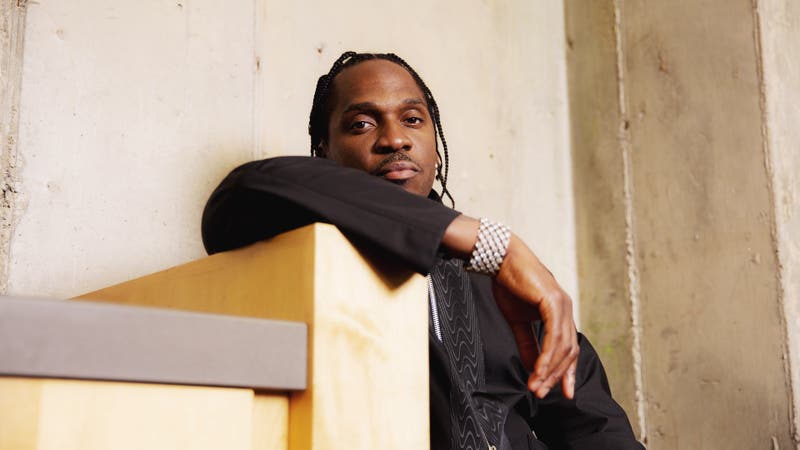
Pusha T Turned a McDonald's Diss Track Into a Perpetual Royalty Check — This Is What Smart Business Looks Like

Andre Thompson
July 20, 2026 · 8 min read
Most rappers take the flat fee. Pusha T negotiated ownership. He now earns royalties every single time Arby's runs a commercial — and that is just one line on a balance sheet that Virginia Beach's most calculated mogul has been quietly building for thirty years.
There is a version of Terrence Levarr Thornton that took the one-time check, did the commercial, and moved on. That version does not exist. The version of Pusha T that exists understood something most artists never learn: a flat fee is an expense. An ownership stake is an asset.
In 2018, Pusha T quietly became the most commercially sophisticated rapper operating in the business, and almost nobody wrote about it at the time. He partnered with Arby's — not as a spokesperson, not for a campaign endorsement fee — but as a collaborator with royalty points. Every time Arby's uses certain jingle elements he developed, King Push earns. The commercials don't stop running. The checks don't stop coming.
That single deal unlocked a level of business thinking that most entertainers spend decades not arriving at.
The Arby's Blueprint
The story starts with the "Spicy Fish Diss" in 2022 — a track Pusha T released targeting McDonald's in explicit partnership with Arby's. On the surface, it looked like a stunt. A rapper making fun of McDonald's fish sandwich for a competing fast food chain. The internet laughed.
Then the numbers came in.
Business analyst Darren Rovell reported that Arby's received $8.2 million in advertising exposure value from the track in a single day — the kind of media saturation that a $10 million paid campaign couldn't replicate. But what the headlines missed was the structure underneath the stunt.
Pusha T had negotiated ownership points on the commercial elements — not a flat fee. Reports indicate he owns approximately 40% of the commercial intellectual property he helped develop for Arby's, meaning he collects a royalty check every time those elements run. Arby's has to pay Pusha T to run their own commercials. He built a revenue stream from a beef.
That is not rap beef. That is business.
GOOD Music and the Label Architecture
Pusha T's business education started earlier — when he and his brother Malice built Clipse into one of the most critically respected rap acts of the 2000s, navigating a distribution nightmare at Jive Records while watching their label mismanage their career. The experience taught him something that most rappers learn too late: labels are not partners. They are creditors.
When Kanye West invited Pusha T to become president of G.O.O.D. Music in 2012, it wasn't just a title. It was a seat at the table of one of music's most prestigious imprints — the label home of Kanye, Big Sean, Kid Cudi, Teyana Taylor, and 2 Chainz at its peak. Running that label gave him operational experience in A&R, artist development, budget management, and deal structuring that most artists never accumulate.
His own King Push Records sits beneath that architecture, operating as the vehicle through which he controls his own masters and publishing. Every record he makes through that structure is an asset he owns outright — not a licensed product he hands to a major label in exchange for an advance.
The 2026 BET Award Moment
In 2026, Pusha T's album "Am I The Drama?" received a BET Award nomination for Album of the Year — confirmation that three decades into his career, the critical establishment still rates him among the top operating artists in hip-hop.
The nomination matters beyond the trophy. Every award cycle returns attention to his catalog, drives streaming numbers, generates new licensing opportunities, and extends the commercial lifecycle of music he already owns. For an artist operating on an ownership model, legacy is not just reputation — it is recurring revenue.
He also announced the Cousinz Festival in Norfolk, Virginia — a music and culture event headlined by himself, T.I., Keyshia Cole, and The-Dream, rooted in the Virginia community that produced him. The festival model is one of the most durable revenue streams in the music industry: own the event, retain the gate, build equity in the brand year over year.
The Virginia Blueprint
What makes Pusha T's business story specific and instructive is the geography. He is not a New York or Los Angeles artist who benefited from existing infrastructure. He built from Virginia Beach — a market with no major label presence, no established rap scene when Clipse emerged — by creating something so undeniable it forced the industry to come to him.
Then he reinvested in that community. The Cousinz Festival is not just a music event — it is an economic activation in a city that raised him, creating jobs, tourism revenue, and cultural capital for a place that mainstream entertainment largely ignores.
The Arby's Lesson, Expanded
The Arby's deal is famous, but the principle underneath it applies far beyond fast food commercials. Pusha T applied the same framework to his label deal, his festival, his fashion collaborations, and his catalog strategy: own the asset, collect the perpetual benefit.
His 2024 collaboration with GOAT — the luxury sneaker and streetwear platform — followed the same pattern. Rather than a one-time ambassador fee, he curated a 24-piece archive that generates ongoing attention and commission. He is building a portfolio of brand equity positions, each one compounding on the others.
This is the operating philosophy of a man who watched the industry extract value from artists for thirty years and decided he would reverse the relationship.
Blueprint Takeaway
1. Never take the flat fee when you can take the points. A one-time payment is an expense for them. A royalty position is an income stream for you. The Arby's deal is a master class in structuring creative work as a long-term asset rather than a transaction.
2. Run the label. Pusha T spent years as a label president before releasing his most important solo work. The operational knowledge he gained translates directly into every business decision he makes as an independent artist.
3. Bring the festival home. Owning a live experience in your home market is one of the most sustainable businesses in entertainment — recurring, community-rooted, and annually renewable.
4. Legacy is a revenue model. Every classic album you own, every award nomination your catalog receives, every decade of credibility you maintain — these are compounding assets. Protect them accordingly.
Virginia Beach gave King Push the hunger. King Push gave Virginia Beach the blueprint.
Did you enjoy this article?
Written by
Andre Thompson
Staff writer at The Hood Forbes Magazine covering business, wealth, and culture.