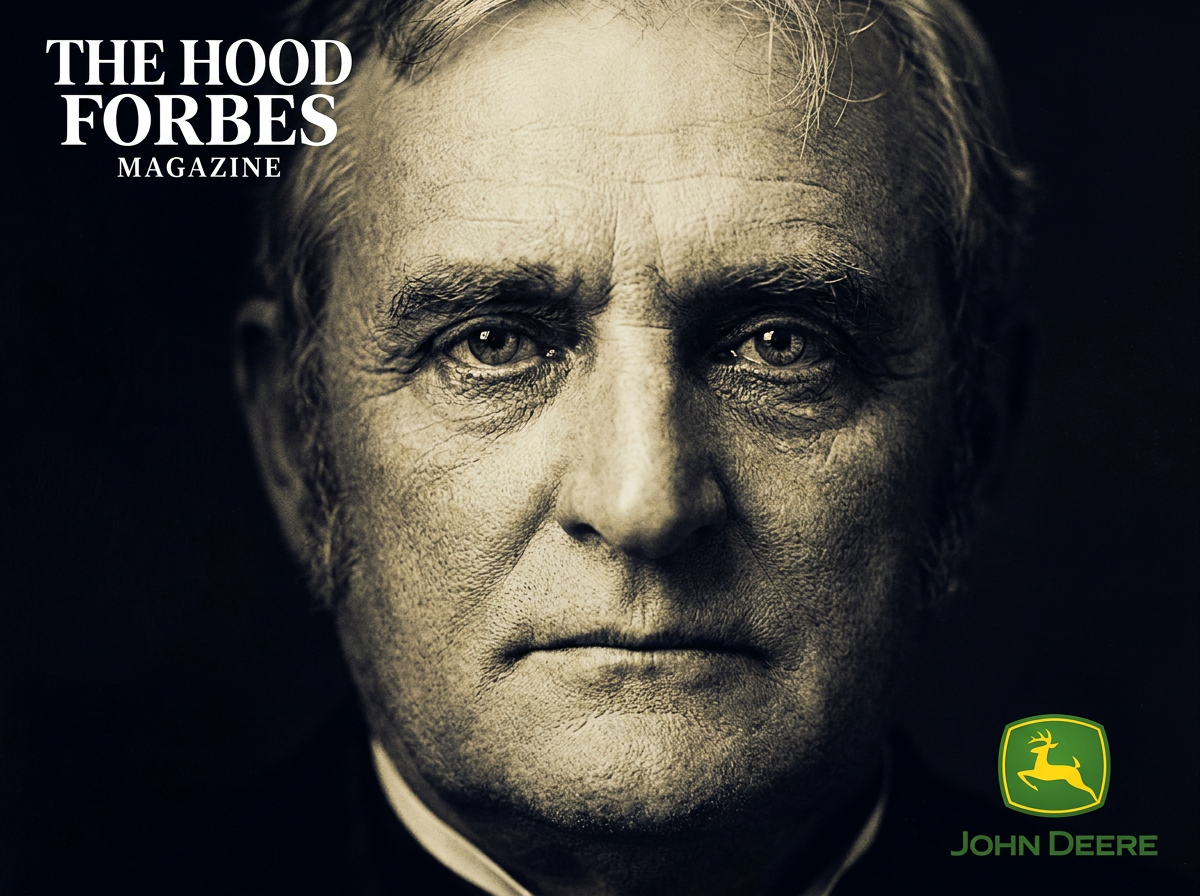
His Name Is the Business: The John Deere Blueprint Nobody Talks About

Hood Forbes Editorial
July 9, 2026 · 8 min read
John Deere died in 1886. His company just posted $15.8 billion in net income last year. This is not a story about a plow. It's a blueprint about what happens when a broke man bets his name on something real — and refuses to let it stand for anything less than his best.
John Deere died in 1886.
His company just posted $15.8 billion in net income last year.
Think about that for a second. The man has been in the ground for nearly 140 years. He never saw a tractor. He never saw a stock ticker. He never saw a Super Bowl commercial, a sponsorship deal, or a licensing agreement. He died before the internal combustion engine was even invented.
And yet his name — two words, a blacksmith's name from rural Vermont — is today one of the most recognized brand identities on earth. You see that yellow and green and you know exactly what it is. You see that leaping deer logo and you know exactly what it stands for. His name alone carries more brand equity than most companies will build in a century of trying.
John Deere didn't just build a business.
He built a name. And the name outlived everything else.
That is the blueprint.
A Broke Man With Nothing But His Word
In 1836, John Deere arrived in Grand Detour, Illinois with almost nothing. He'd left Vermont owing money to creditors, leaving behind a wife and children, starting completely over in a place where nobody knew him.
What he had was a skill — blacksmithing — and a reputation he hadn't built yet.
He watched Midwest farmers struggling with a problem everyone had accepted as just the way things were. The cast-iron plows they'd brought from the East couldn't handle the heavy prairie clay. The soil stuck to the blade. Farmers stopped every few feet to scrape it clean. It was slow, brutal, grinding work with no end in sight.
In 1837, Deere found a broken steel saw blade and went to work.
He fashioned it into a self-scouring plow — smooth steel that let the prairie soil slide right off. No clogging. No stopping. No scraping. The plow did what it was supposed to do.
He didn't wait for orders. He made three plows before a single farmer asked him to.
He was betting that solving a real problem was enough to build on. He was right.
By 1842 he was making 100 plows a year. By 1855, 13,000. From a broken blade worth almost nothing to a manufacturing operation that was feeding an entire region — in under twenty years, with no outside capital, no investors, no safety net.
But here's the part that most business writers skip right past:
Deere could have sold those plows under any name. He could have branded them anything. He could have hid behind a company name the way so many founders do.
He didn't.
He put his own name on it. And he meant it.
"I Will Never Put My Name On a Product That Does Not Have the Best in Me"
That quote is real. John Deere actually said it.
And it wasn't marketing copy. It wasn't something a brand consultant cooked up. It was a business philosophy that became the entire identity of the company — because when your name IS the company, your reputation IS the product.
This is the piece of the story that carries the most weight for entrepreneurs today.
Deere understood something that most business owners learn too late: when you put your name on something, you are making a promise that your name has to keep forever. Every plow that broke in a field, every delivery that came in wrong, every customer who felt cheated — that wasn't just a bad product experience. That was John Deere's name attached to a failure.
So he obsessed over quality. Not because he was a perfectionist by nature, but because he was protecting the only real asset he had — his name in the market.
He insisted on better steel when local iron wasn't good enough. He moved his entire operation to Moline, Illinois in 1848 to get better access to raw materials and shipping. He reinvested constantly. He refused to cut corners even when cutting corners would have been more profitable in the short term.
Because he knew: short-term profit built with a compromised name is long-term destruction.
His competitors made cheaper plows. Some of them sold more units in certain years. None of them are household names today.
John Deere is.
The Name Becomes the Company. The Company Becomes the Name.
Here is how you know when a name has truly become a business:
People stop using the generic term and start using your name instead.
You don't ask for a tissue. You ask for a Kleenex. You don't ask for a photocopy. You ask for a Xerox. You don't say you're going to search something online. You say you're going to Google it.
In agricultural communities across America, for generations, people didn't say "the farm equipment." They said "the John Deere." The name wasn't describing the product. The name WAS the product.
That level of brand penetration doesn't happen because you have a good logo. It happens because you deliver consistently, at scale, over a long period of time, and your name becomes the mental shortcut for quality in your entire category.
John Deere's name was incorporated into the company in 1868 — Deere & Company. He sat as president until his death. But the machinery of the brand — the trust, the recognition, the identity — that was built plow by plow, customer by customer, year by year, long before any legal incorporation happened.
By the time John Deere died, the name had already taken on a life bigger than the man.
That is generational wealth. Not money in an account. A name in a market.
The Blueprint: What Putting Your Name On It Really Means
Most people think "putting your name on it" is about ego. About credit. About wanting recognition.
John Deere shows you it's about something else entirely.
It's a performance guarantee. When your name is on the product, you cannot hide from bad work. There is no corporate shield between you and the customer's judgment. Your name is the guarantee. That pressure either breaks you or makes you exceptionally good. Deere let it make him exceptionally good.
It's a compounding asset. A product can be copied. A patent expires. A design can be replicated. But a name that has earned trust over decades — in real communities, with real results — cannot be manufactured overnight. Every year Deere put out a quality plow, his name became worth more. Not because of marketing. Because of proof.
It's a legacy strategy. John Deere didn't just build a company. He built something his family could inherit. His son Charles Deere took over after him and grew the company further. The name transferred because the values transferred. The standard was set. The brand had a definition. Whoever carried the name forward had to carry the standard with it.
It's the ultimate accountability structure. You cannot outsource your name. You can outsource production, distribution, marketing. But the reputation attached to your name? That follows you everywhere and outlives everything. Build it right and it generates returns long after you're gone. Build it wrong and it collapses the same way.
What This Means for You
Here's the part that matters for every Black entrepreneur, every culture-forward brand builder, every founder who came up with nothing and is trying to build something that lasts:
Your name is not separate from your business.
Your name is the business.
The reason Hood Forbes puts real names and real stories front and center isn't ceremony. It's strategy. Names carry history. Names carry trust. Names carry the weight of everything that was sacrificed to put them in a position to mean something.
John Deere was a broke blacksmith in 1836. His name now sits on a company worth over $100 billion. That isn't a coincidence. That isn't luck. That isn't even primarily about the plow.
It's about what he decided his name was going to mean — and then spending the rest of his life making sure it meant that.
The question isn't whether you can build a business.
The question is: what is your name going to stand for?
Because if you build it right, your name will keep working long after you stop.
That is the real John Deere story.
Move accordingly.
Did you enjoy this article?
Written by
Hood Forbes Editorial
Staff writer at The Hood Forbes Magazine covering business, wealth, and culture.